


Tratamientos
Shockwave Argentina is a medical facility run by Dr. César Eisner (MN: 64,575) and dedicated specifically to the noninvasive treatment of male sexual dysfunction. The sexual dysfunctions treated include: fibrogenic erectile dysfunction, neurogenic erectile dysfunction, macro- and micro-venous leaks, Peyronie's disease (penile curvature), penile retraction, pelvic pain, and chronic prostate pain. In principle, successful treatment requires an accurate diagnosis, given that, for example, erectile dysfunction can be due to different causes and even several combined, with varying degrees of severity in each case. Therefore, each treatment is personalized. For this reason, we initially conduct a treatment readiness consultation, which includes a clinical evaluation, two-dimensional ultrasound, color Doppler ultrasound, and 2D-SWE or Shear Wave Elastography. With the data obtained in this consultation, a diagnosis and prognosis can be established immediately, and the appropriate treatment can be budgeted.

What do the treatments consist of?
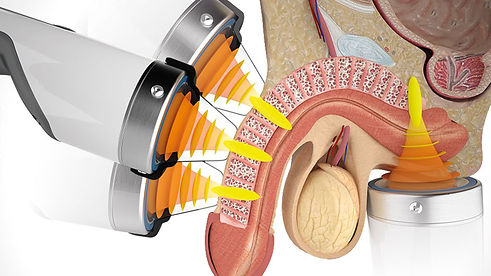
Treatments are performed using low-intensity focused shock waves using state-of-the-art Swiss equipment. The biological mechanism of action of low-intensity shock waves is to stimulate cell nuclei in the affected tissues, thereby activating genetic mechanisms that restore and replenish muscle fibers, blood vessels, and nerve fibers, allowing the penile structure and function to return to normal. The results, in addition to the patient's clinical response, can be objectively demonstrated through qualitative and quantitative monitoring of images using 2D-SWE elastography. The treatments are noninvasive, painless, have no adverse effects, can even be applied to diabetics or those who have undergone prostate surgery, have no age limit, and the results are long-lasting.
Erectile Dysfunction
Since diagnosis is multicausal in most cases, in addition to considering hormonal, metabolic, medication, clinical, and psychological factors, we now have medical equipment that allows us to evaluate the condition of nerve pathways, blood vessels, and the elastic state of cavernous tissues. Furthermore, knowledge of molecular biology and epigenetics allows us to understand the principles that generate noninvasive shock wave treatments, promoting the replacement of fibrous tissue with elastic and perfectly functional tissue through the release of exosomes containing structural proteins, growth factors, DNA, and different types of RNA. In short, common sense, understanding that the restoration of all the causal components of erectile dysfunction is required in each individual patient, allows us today to have the real possibility of obtaining a cure for erectile dysfunction.
Disfunción Eréctil Fibrogénica
Durante la mayor parte del siglo XX no se pudo encontrar tratamientos eficaces para la disfunción eréctil hasta que recién en 1998, con la aparición del sildenafil, la famosa "pastilla azul", comenzaron a verse resultados al menos transitorios. Esta solución fue debida a que la atención no se centró en resolver los aspectos hormonales ni vasculares del trastorno sino en mantener la condición elástica de los sinusoides cavernosos, con lo cual se consiguió sostener erecciones satisfactorias. Sucede que a lo largo de los años o por diferentes motivos (diabetes, inyecciones intracavernosas, tratamientos con finasteride, traumatismos, etc.), el músculo liso cavernoso perisinusoidal se va fibrosando y perdiendo su "complianza", limitando su capacidad expansiva y generando una disfunción eréctil fibrogénica. Este tipo de disfunción es perfectamente diagnosticable mediante elastografía 2D-SWE y tratable exitosamente mediante los tratamientos con ondas de choque focalizadas de baja intensidad gracias a las cuales, por medio de la mecanotransducción, el tejido fibroso es reemplazado en pocas sesiones por tejido sano, elástico y perfectamente funcional, permitiendo resolver la disfunción eréctil de forma duradera.

Penile curvature or Peyronie's disease
One of the sexual dysfunctions in men is Peyronie's disease or acquired penile curvature. It is caused by the presence of rigid areas that, when they do not yield during erection, cause the curvature. Shock waves act by stimulating cell nuclei to release growth factors and synthesize structural proteins, generating new elastic fibers to replace the rigid fibers, thus restoring the elasticity of the affected tissues. By using a 2D SWE SSI elastograph at Shockwave Argentina, we are able to make an accurate diagnosis and objectively monitor treatment outcomes. Beyond clinical improvement, we can measure the tensile forces that produce the curvature in kilopascals and on a color scale. The treatment, considered a "noninvasive regenerative biosurgery," is painless, has no adverse effects, is performed in a few sessions, and also improves erectile function.

Venous leak
The discovery of cavernous vein varicose veins at the level of the penile trunk or roots with dilations greater than 2 mm is associated with venous leakage in all patients with this condition. To correct this situation, the application of low-intensity focused shock waves results in a reduction in the caliber of these venous dilations. The mechanism of action consists of increasing the vascularization of the cavernous bodies and roots, mediated by VEGF, to improve perivenous muscle tone and trophism, given the poor response obtained with venotonic medications. The results obtained after four sessions of 3000 focal waves each (one to two per week), with a frequency between 3 and 4 Hz and a power of 0.25 mJ/mm2, achieved a reduction in vein caliber by more than 70% of its original caliber, along with a noticeable improvement in symptoms.
Erectile Dysfunction in Prostate Surgery
The prostate is a gland whose main functions are to produce seminal fluid and facilitate ejaculation. Although it is not directly involved in the erectile mechanism, as it is surrounded by the nerves that innervate the penis, if these are injured or cut during surgery, they will directly affect the erection. Today, surgeons are very careful not to damage these nerves, but some degree of postoperative erectile dysfunction often occurs due to the extreme fragility of the nerve pathways (neurogenic erectile dysfunction). To determine whether erectile dysfunction is of neurogenic origin, we rely on highly reliable neurological studies, including: penile electromyogram with sensory and motor conduction velocity, pudendal cortical evoked potentials, and bulbocavernosus reflex. In any case, since erectile dysfunction has multiple causes, a meticulous clinical evaluation and other diagnostic studies, such as vasoactive drug-free color Doppler ultrasound and 2D penile SWE elastography, will also be necessary for a complete assessment of the dysfunction. The results of the studies will determine whether or not there is nerve damage, and if so, whether it is mild, moderate, severe, or complete. Depending on the extent of the damage, at Shockwave Argentina we have experience applying different treatment protocols, taking into account that in the peripheral nervous system, unlike the central nervous system, damage is potentially repairable.


Obesity and diabetes
La obesidad y la diabetes, como componentes del Síndrome Metabólico, cuentan con múltiples mecanismos capaces de incrementar el riesgo de presentar disfunción eréctil, y uno de los principales mecanismos responsables es la disfunción endotelial, la que lleva a la fibrosis de los tejidos peneanos constituyendo una disfunción eréctil fibrogénica. Además, el aumento de la presión abdominal puede llevar a una disfunción eréctil vasculogénica. En la diabetes, los recurrentes picos de hiperglucemia mayores 150 miligramos por decilitro producen disfunción endotelial en los cuerpos cavernosos principalmente a través de una combinación de mecanismos tales como el estrés oxidativo, disfunción del óxido nítrico, glicación avanzada, inflamación crónica, alteración del flujo sanguíneo, apoptosis del músculo liso y disminución del factor de crecimiento vascular endotelial. Por su parte, la obesidad está relacionada con niveles bajos de testosterona, ocasionando un hipogonadismo secundario, disminuyendo la libido y afectando la capacidad eréctil. Además, el tejido graso excesivo convierte la testosterona en estrógenos mediante la enzima aromatasa, desequilibrando los niveles de las hormonas sexuales. En Shockwave Argentina contamos con profesionales altamente capacitados y tecnología médica de última generación para darle una solución efectiva a sus problemas.